Showing posts with label Empirical science. Show all posts
Showing posts with label Empirical science. Show all posts
Tuesday, June 25, 2013
Interactive Animated Split Brain Experiment Thingy
This here as an Interactive Animated Split Brain Experiment Thingy: The Split Brain Experiments

Monday, June 24, 2013
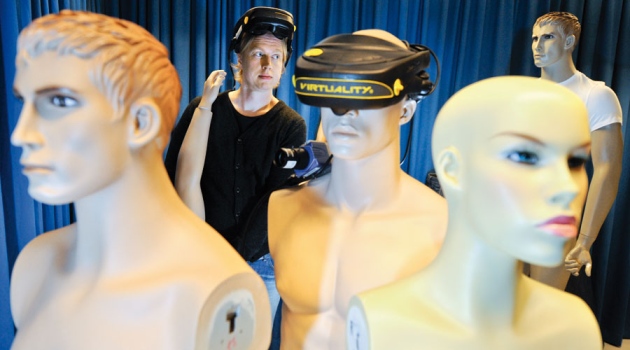
Out-of-body experience: Master of illusion : Nature News & Comment
Out-of-body experience: Master of illusion : Nature News & Comment:
"Henrik Ehrsson uses mannequins, rubber arms and virtual reality to create body illusions, all in the name of neuroscience."
Monday, January 28, 2013
Wednesday, January 16, 2013
Parasites Use Sophisticated Biochemistry to Take Over Their Hosts - NYTimes.com
Parasites Use Sophisticated Biochemistry to Take Over Their Hosts - NYTimes.com: The current issue of the prestigious Journal of Experimental Biology is entirely dedicated to such examples of zombies in nature. They are far from rare. Viruses, fungi, protozoans, wasps, tapeworms and a vast number of other parasites can control the brains of their hosts and get them to do their bidding. But only recently have scientists started to work out the sophisticated biochemistry that the parasites use.
Wednesday, November 16, 2011
Mimicking the brain, in silicon - MIT News Office

For decades, scientists have dreamed of building computer systems that could replicate the human brain’s talent for learning new tasks.
MIT researchers have now taken a major step toward that goal by designing a computer chip that mimics how the brain’s neurons adapt in response to new information. This phenomenon, known as plasticity, is believed to underlie many brain functions, including learning and memory.
Saturday, October 8, 2011
Octophilosophy | The Scientist
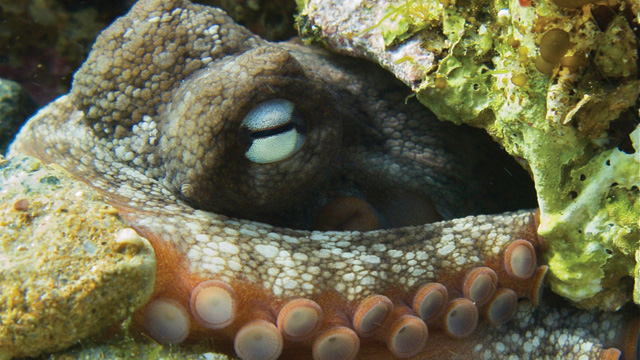
"Godfrey-Smith decided to connect this biological concept with his interest in the philosophy of mind, particularly in nonhumans. In 2010, he began a project with Alexandra Schnell, a graduate student at Macquarie University in Sydney, to conduct behavioral observation studies that address whether octopus intelligence differs from that of other species. Do octopuses learn differently? Does the decentralization of neurons mean cephalopods have multiple minds or competing consciousnesses?"
Tuesday, October 4, 2011
Online visual guide to the brain
An online visual guide to the brain: Brain Function, Anatomy & Diagram | Body Maps
Monday, October 3, 2011

Monday, September 26, 2011
Scientists use brain imaging to reveal the movies in our mind
Scientists use brain imaging to reveal the movies in our mind:
"Using functional Magnetic Resonance Imaging (fMRI) and computational models, UC Berkeley researchers have succeeded in decoding and reconstructing people’s dynamic visual experiences – in this case, watching Hollywood movie trailers. As yet, the technology can only reconstruct movie clips people have already viewed. However, the breakthrough paves the way for reproducing the movies inside our heads that no one else sees, such as dreams and memories, according to researchers."
Mental rotation
One line of research in empirical science that is pertinent to the topics of imagination and mental imagery involves a phenomenon known as "mental rotation." The following is excerpted from the "Mental Rotation" supplement to the "Mental Imagery" entry at the Stanford Encyclopedia of Philosophy:
Shepard & Metzler (1971) introduced the concept of mental rotation into cognitive science with what has become one of the best-known experiments in the field. This fame may, in part, be because the experiment is associated with a set of memorable graphical images (e.g., figure 1), some of which made it onto the cover of the issue of Science where it was first published. However, it is also a remarkably elegant experiment, that produced some strikingly clear results. The findings seemed directly to refute the Behaviorist doctrine, still holding considerable sway amongst psychologists at the time, that thought processes depend entirely upon language. By suggesting that analog representations have an important role to play in thinking, the findings also raised prima facie difficulties (though not necessarily insurmountable ones) for the (digital) computer model of the mind that lay at the heart of the newly emerging field of cognitive science (Block, 1983a).

Figure 1
Some of the stimulus figure pairs used by Shepard & Metzler (1971).
A- Identical objects differing by a rotation in the plane of the page
B – Identical objects differing by a rotation in depth
C – Mirror-image objects (also rotated in depth)
Shepard & Metzler presented their subjects with pairs of drawings of three-dimensional, asymmetrical assemblages of cubes, as shown in figure 1 A, B, and C. In each pair, the right-hand picture either showed an assemblage identical to that shown on the left, but rotated from the original position by a certain amount, or else it showed an assemblage that was not only rotated, but was also the mirror image of the one to the left (figure 1 C). The experimental task was to tell, as quickly as possible (by pressing a button) whether the two objects depicted were in fact identical (except for rotation), or were mirror images. Shepard's hypothesis was that the task would be done by forming a three-dimensional mental image of one of the depicted objects, and rotating this whole image, in the imagination, to see whether it could be brought into correspondence with the other picture. The experimental results clearly supported this idea, because it was found that, for each subject, the time taken to confirm that both objects of a pair were, in fact, identical, increased in direct proportion to the angular rotational difference between them. It was as if the subjects were rotating their mental image at a steady rate (although this might be different for each subject), so that the further they had to go to bring their image into correspondence with the reference picture, the longer it would take them. On post-experimental questioning, most of the subjects confirmed that this was indeed how they believed that they had done the task. (Interestingly, it made no difference whether the rotation was in the plane of the page, or in depth.)
Wednesday, September 21, 2011
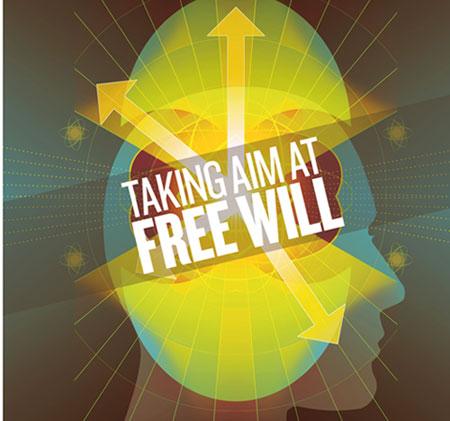
Neuroscience vs philosophy: Taking aim at free will : Nature News
Excerpt:
The experiment helped to change John-Dylan Haynes's outlook on life. In 2007, Haynes, a neuroscientist at the Bernstein Center for Computational Neuroscience in Berlin, put people into a brain scanner in which a display screen flashed a succession of random letters. He told them to press a button with either their right or left index fingers whenever they felt the urge, and to remember the letter that was showing on the screen when they made the decision. The experiment used functional magnetic resonance imaging (fMRI) to reveal brain activity in real time as the volunteers chose to use their right or left hands. The results were quite a surprise.
"The first thought we had was 'we have to check if this is real'," says Haynes. "We came up with more sanity checks than I've ever seen in any other study before."
The conscious decision to push the button was made about a second before the actual act, but the team discovered that a pattern of brain activity seemed to predict that decision by as many as seven seconds. Long before the subjects were even aware of making a choice, it seems, their brains had already decided.
The Mind Uploading Home Page

Excerpt:
The Mind Uploading home page is dedicated to the putative future process of copying one's mind from the natural substrate of the brain into an artificial one, manufactured by humans. This technology will radically alter society in many ways, as science fiction authors have begun to illustrate. Through this server, explore the science behind the science fiction!See also, this article: "Uploading the Mind".
Tuesday, September 20, 2011
Mollusks evolved brains on four different occasions

One of the early and famous arguments that the philosopher Hilary Putnam made in favor of functionalism involved pointing out how it is likely that humans and octopuses have very different nervous systems while similar mental states such as pains. Here's an interesting and pertinent article on the brains of mollusks:
Mollusks evolved brains on four different occasions
Monday, September 19, 2011
First post in This Is Philosophy of Mind

This first post serves just to test some features of the blog. More stuff is coming soon.
Subscribe to:
Posts (Atom)