On-line Turing Machine simulators.
http://ironphoenix.org/tril/tm/
http://morphett.info/turing/turing.html
Showing posts with label Functionalism. Show all posts
Showing posts with label Functionalism. Show all posts
Saturday, December 29, 2012

Monday, December 10, 2012
Spaun brain activity and decoding for sample tasks - YouTube
Spaun brain activity and decoding for sample tasks - YouTube
From Science (http://www.sciencemag.org/content/338/6111/1202):
From Science (http://www.sciencemag.org/content/338/6111/1202):
A Large-Scale Model of the Functioning Brain
Eliasmith et al
Abstract:
A central challenge for cognitive and systems neuroscience is to relate the incredibly complex behavior of animals to the equally complex activity of their brains. Recently described, large-scale neural models have not bridged this gap between neural activity and biological function. In this work, we present a 2.5-million-neuron model of the brain (called “Spaun”) that bridges this gap by exhibiting many different behaviors. The model is presented only with visual image sequences, and it draws all of its responses with a physically modeled arm. Although simplified, the model captures many aspects of neuroanatomy, neurophysiology, and psychological behavior, which we demonstrate via eight diverse tasks.
Tuesday, September 11, 2012
Inside the mind of the octopus | Orion Magazine
Inside the mind of the octopus | Orion Magazine:
Only recently have scientists accorded chimpanzees, so closely related to humans we can share blood transfusions, the dignity of having a mind. But now, increasingly, researchers who study octopuses are convinced that these boneless, alien animals—creatures whose ancestors diverged from the lineage that would lead to ours roughly 500 to 700 million years ago—have developed intelligence, emotions, and individual personalities. Their findings are challenging our understanding of consciousness itself.
Wednesday, November 16, 2011
Mimicking the brain, in silicon - MIT News Office

For decades, scientists have dreamed of building computer systems that could replicate the human brain’s talent for learning new tasks.
MIT researchers have now taken a major step toward that goal by designing a computer chip that mimics how the brain’s neurons adapt in response to new information. This phenomenon, known as plasticity, is believed to underlie many brain functions, including learning and memory.
Saturday, October 8, 2011
Octophilosophy | The Scientist
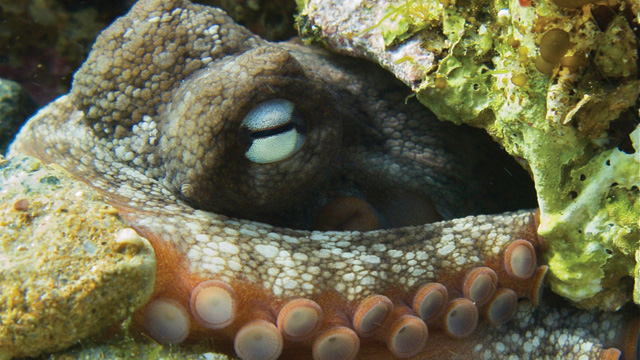
"Godfrey-Smith decided to connect this biological concept with his interest in the philosophy of mind, particularly in nonhumans. In 2010, he began a project with Alexandra Schnell, a graduate student at Macquarie University in Sydney, to conduct behavioral observation studies that address whether octopus intelligence differs from that of other species. Do octopuses learn differently? Does the decentralization of neurons mean cephalopods have multiple minds or competing consciousnesses?"
Monday, October 3, 2011

Wednesday, September 21, 2011
The Mind Uploading Home Page

Excerpt:
The Mind Uploading home page is dedicated to the putative future process of copying one's mind from the natural substrate of the brain into an artificial one, manufactured by humans. This technology will radically alter society in many ways, as science fiction authors have begun to illustrate. Through this server, explore the science behind the science fiction!See also, this article: "Uploading the Mind".
Tuesday, September 20, 2011
Mollusks evolved brains on four different occasions

One of the early and famous arguments that the philosopher Hilary Putnam made in favor of functionalism involved pointing out how it is likely that humans and octopuses have very different nervous systems while similar mental states such as pains. Here's an interesting and pertinent article on the brains of mollusks:
Mollusks evolved brains on four different occasions
Philosophy Bro on the Chinese Room

Philosophy Bro: Mailbag Monday: The Chinese Room
Excerpt:
Before I get into the experiment itself, here's the problem Searle is addressing - what does it mean for a machine to understand something? Is it possible we will ever produce a machine that can think on its own, that can learn and truly understand English? Offhand, it seems possible; after all, if we build a robot that speaks English as well as we do, who understands the nuances of language, who we just can't tell is a robot, then what exactly is the difference between his claim to know English and your best friend's claim to know English? This is the basis of the famous 'Turing Test' for AI - when we reach the point where we can no longer distinguish between a human and a computer when speaking to them, then we have truly achieved Artificial Intelligence.
Monday, September 19, 2011
Chinese room from the Philosophy of Mind MetaResource

- Eliasmith's Dictionary of Philosophy of Mind (DPM)
- The Stanford Encyclopedia of Philosophy (SEP)
- A Field Guide to the Philosophy of Mind (FG)
- The Internet Encyclopedia of Philosophy (IEP)
- Brain Hammer (BH)
Here's a sample entry:
Chinese room
[DPM] [SEP] [FG] [IEP] [BH]
Subscribe to:
Posts (Atom)