
Showing posts with label Pictures. Show all posts
Showing posts with label Pictures. Show all posts
Monday, May 12, 2014

Wednesday, February 12, 2014

Wednesday, May 29, 2013

Tuesday, January 8, 2013
Monday, January 7, 2013
Wednesday, October 3, 2012
Illustrations from "Consciousness: An Introduction" by Susan Blackmore
Jolyon's Website - Consciousness - An Introduction: Illustrations from "Consciousness: An Introduction" by Susan Blackmore (Hodder, 2003).
Friday, August 17, 2012
Tuesday, July 31, 2012
Correspondence between Descartes and Princess Elisabeth

http://www.earlymoderntexts.com/pdf/descelis.pdf

Wednesday, March 28, 2012
Thursday, October 20, 2011

Tuesday, October 4, 2011
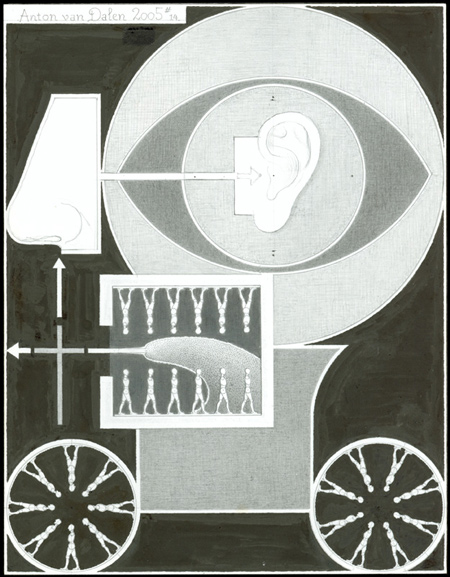
Drawings by Anton Van Dalen
Monday, September 26, 2011
Mental rotation
One line of research in empirical science that is pertinent to the topics of imagination and mental imagery involves a phenomenon known as "mental rotation." The following is excerpted from the "Mental Rotation" supplement to the "Mental Imagery" entry at the Stanford Encyclopedia of Philosophy:
Shepard & Metzler (1971) introduced the concept of mental rotation into cognitive science with what has become one of the best-known experiments in the field. This fame may, in part, be because the experiment is associated with a set of memorable graphical images (e.g., figure 1), some of which made it onto the cover of the issue of Science where it was first published. However, it is also a remarkably elegant experiment, that produced some strikingly clear results. The findings seemed directly to refute the Behaviorist doctrine, still holding considerable sway amongst psychologists at the time, that thought processes depend entirely upon language. By suggesting that analog representations have an important role to play in thinking, the findings also raised prima facie difficulties (though not necessarily insurmountable ones) for the (digital) computer model of the mind that lay at the heart of the newly emerging field of cognitive science (Block, 1983a).

Figure 1
Some of the stimulus figure pairs used by Shepard & Metzler (1971).
A- Identical objects differing by a rotation in the plane of the page
B – Identical objects differing by a rotation in depth
C – Mirror-image objects (also rotated in depth)
Shepard & Metzler presented their subjects with pairs of drawings of three-dimensional, asymmetrical assemblages of cubes, as shown in figure 1 A, B, and C. In each pair, the right-hand picture either showed an assemblage identical to that shown on the left, but rotated from the original position by a certain amount, or else it showed an assemblage that was not only rotated, but was also the mirror image of the one to the left (figure 1 C). The experimental task was to tell, as quickly as possible (by pressing a button) whether the two objects depicted were in fact identical (except for rotation), or were mirror images. Shepard's hypothesis was that the task would be done by forming a three-dimensional mental image of one of the depicted objects, and rotating this whole image, in the imagination, to see whether it could be brought into correspondence with the other picture. The experimental results clearly supported this idea, because it was found that, for each subject, the time taken to confirm that both objects of a pair were, in fact, identical, increased in direct proportion to the angular rotational difference between them. It was as if the subjects were rotating their mental image at a steady rate (although this might be different for each subject), so that the further they had to go to bring their image into correspondence with the reference picture, the longer it would take them. On post-experimental questioning, most of the subjects confirmed that this was indeed how they believed that they had done the task. (Interestingly, it made no difference whether the rotation was in the plane of the page, or in depth.)
Thursday, September 22, 2011
Picturing mental causation
Some of the main proposals concerning the general structure of mental causation can be pictured in the following ways (from the Internet Encyclopedia of Philosophy entry on mental causation):
Interactionism:
Parallelism:
Epiphenomenalism:
Reductionism:
Interactionism:
Parallelism:
Epiphenomenalism:
Reductionism:
Tuesday, September 20, 2011

Subscribe to:
Posts (Atom)